RISE and FALL of the ASSYRIAN EMPIRE (1 of 2)
Rise and Fall of the Assyrian Empire
Assyrians conquer and a decline in Yahweh worship | Assyria's demise and Judah's Independence lost again
Assyrians conquer and a decline in Yahweh worship
Populations had been growing in the Middle East. In the 700s BCE, Assyria's trade had expanded, and trade and the spoils of war had brought to Assyria more wealth than any other state. Its cities had become large metropolitan centers.
The Assyrians were as religious as their neighbors, believing like others that disasters were caused by displeasing the gods. Assyrian women were veiled – except for prostitutes, slave-women and unmarried priestesses, whom the law forbade to wear veils in public. Abortion was considered immoral and a crime against the state. A woman who willfully caused a miscarriage was impaled on a stake and left unburied. "Unnatural" sexual acts were forbidden and severely punished.
In 745 BCE , a military coup in Assyria brought to power a general who made himself king and called himself Tiglath-Pileser III. Meanwhile, Jeroboam II of Israel had died, and son and successor, Zechariah, ruled Israel for only six months before he was assassinated. Then Israel weakened itself with civil war, and this weakness made expanding southward more attractive for Tiglath-Pileser III. He decided to expand the realm of Assyria's god, Assur, and to win for himself more wealth. He created a new, permanent army, largely of well-trained and disciplined mercenaries – an army unmatched in West Asia and North Africa. Tiglath-Pileser's army had iron weapons, siege machines that could break down city walls, and they had archers on horseback who could move fast in hilly terrain.

Kingdoms in the Middle East around 830 BCE click to enlarge
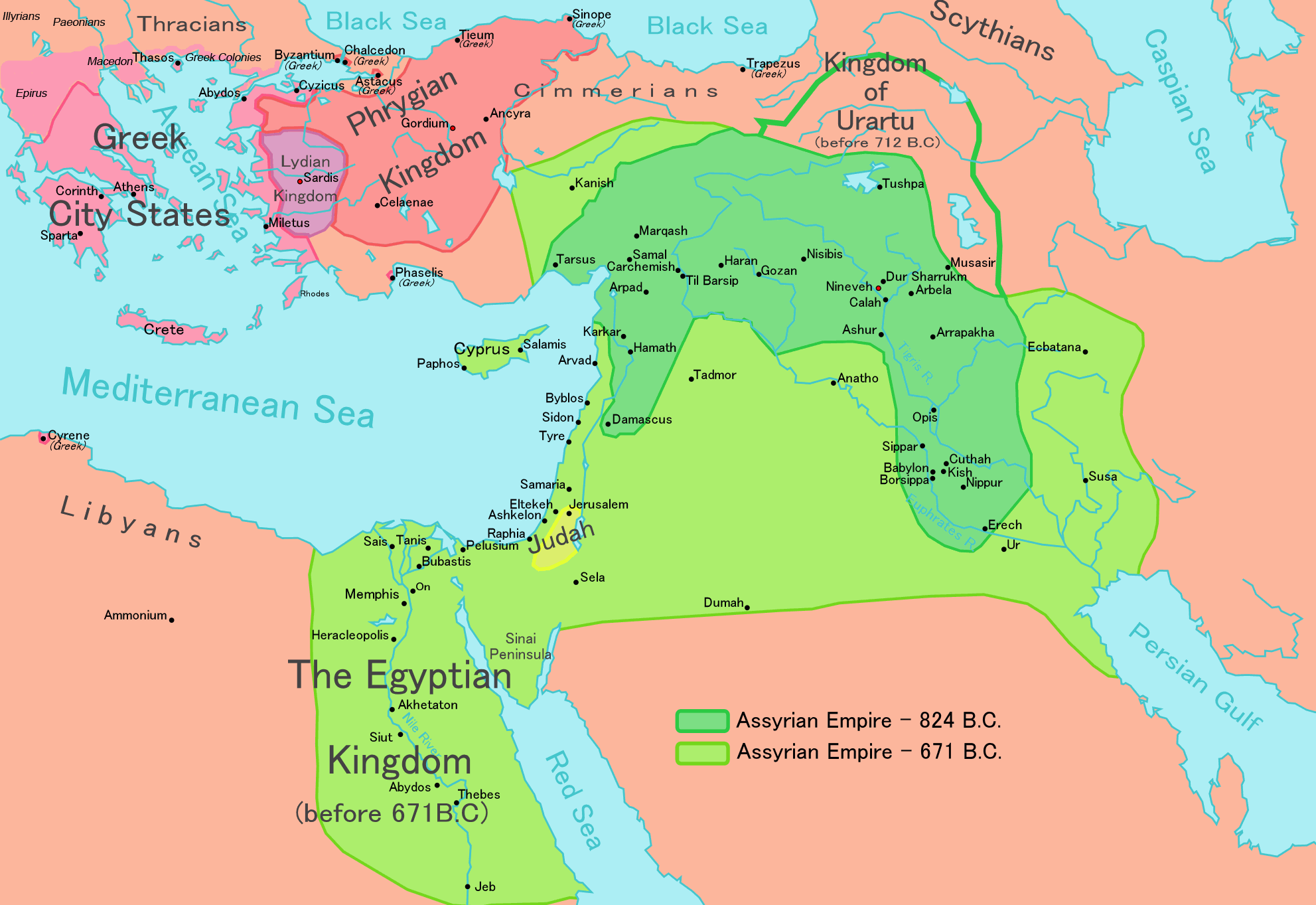
Middle East and Assyrian Empire, 800 to 671 BCE, click to enlarge

Tiglath-Pileser III. Like other conquerors in ancient times, described himself as an agent of his god, Assur.
Tiglath-Pileser defeated tribes that had been menacing the Assyrians and others. Waging total war, he extended Assyrian rule across Syria, expelling the Urartians and conquering Syria's Aramaean city-states, including King Ahab's old ally, Damascus. He destroyed cities, robbed and often deported whole populations, resettling them elsewhere in order to disunite them and put an end to their consciousness as a nation.
The Assyrians Overrun Israel
In 733, Tiglath-Pileser's army conquered Gilead and Galilee. Bending to the realities of power, Israel recognized Assyria's domination and paid Assyria tribute. Assyria replaced the king of Israel with someone of their choosing: Hoshea. Then Hoshea rebelled against paying tribute. Hoshea sent messengers to Egypt, hoping to win an alliance with Egypt. The worried kings of Tyre and Sidon also sought an alliance with Egypt. But before Hoshea could create any meaningful alliance, Assyria attacked.
Some Israelites fled before the invaders. For three years the Assyrians besieged Israel's capital, Samaria. In 721, under a new king, Sargon II, Assyria conquered Samaria. Then Assyria conquered the whole of Israel. As they had done with other nations they had conquered they deported and dispersed large numbers of people. The Assyrians took 27,000 Israelis away as slaves, and Israel as a nation vanished.
Meanwhile, according to the archeologist Finkelstein, a "torrent of refugees" moving south into Judah expanded Judah's population. Judah was now to be overrun by the Assyrians and to become an Assyrian vassal. It was then, according to Finkelstein that "Judah emerges as a full-blown bureaucratic state." note4
The Assyrians Overrun Judah and Egypt
According to the Old Testament, another Hebrew prophet who addressed the issue of Assyrian aggression was Isaiah – a nobleman from Jerusalem. Isaiah joined the prophet Hosea in opposing alliances. He saw wisdom in pacifism rather than relying on arms. He believed that what mattered above all else was devotion to their god Yahweh (Jehovah). Like Hosea, Isaiah saw the Assyrians, as the agents of Yahweh.
But the king of the Assyrians, Sargon II's son, Sennacherib, pushed his army beyond Israel and into Judah. The Assyrians laid waste to Judah's countryside and gathered before the walls of Jerusalem. They threatened to destroy Jerusalem unless the city paid a ransom. The city paid, and Jerusalem was spared.
According to Isaiah, the Assyrians as agents of Yahweh had suddenly come to an end. Isaiah quoted Yahweh as saying "I will save Jerusalem for my own sake and for my servant David's sake" (Isaiah 37:35). According to the Second Book of Kings, 19:36, Yahweh intervened against the Assyrians, sending an angel during the night into their camp and slaying 185,000 Assyrian soldiers in their sleep.
The impact of such a loss would have reversed Assyrian gains, but no description of events in Assyrian writings compatible with such an event has been found. And rather than suffering a reversal, the Assyrians were able to continue their rule over Judah. Sennacherib's great Assyrian army continued its victorious march southward. The Assyrians occupied Egypt in 676, introducing iron to the region, and a few years later they sacked the city of Thebes. A weakened Egypt, meanwhile, had been invaded by Nubia. A Nubian had become pharaoh. The Assyrians defeated the Nubian pharaoh, and the Nubians withdrew to their homeland.
By 640 BCE, Assyria had also extended its rule south along the Tigris and Euphrates rivers to the Persian Gulf, and they had extended their empire northeast into mountainous territory and south into Arabia. Assyria had created a great empire: all of Mesopotamia, Egypt, Cyprus, Syria and west of Kanesh in Asia Minor. They believed that they were enjoying the blessings of their great god, Assur. In the lands that the Assyrians conquered they established the same kind of peace that Hammurabi had created in Mesopotamia. The Assyrians built roads, which helped West Asia become more integrated economically and helped trade and industry flourish.
A Decline in Yahweh Worship
In Judah the Hebrew king from around 692 BCE, Manasseh, ruled as Assyria's puppet. He gave his support to the god Assur, whose image he placed at the entrance to the temple that Solomon had built for Yahweh. He allowed pagan priests in the "House of the Lord" alongside the priests of Yahweh. Writing that would find its way into Hebrew scripture would describe Manasseh as having erected altars for Ba'al worship, practicing witchcraft, using divination and mediums. It would describe Manasseh as having "seduced" the people of Jedah "to do evil."
Hebrew scipture would described some in Judah as dismayed at Yahweh's toleration of the success of the wicked and the subjugation of the righteous. Many in Judah saw Yahweh as having abandoned them, or they lost faith in Yahweh's ability to do anything for their benefit. Merchants in Judah abandoned their identities and as Hebrews, and they adopted foreign dress.
Manasseh enjoyed more that fifty years of rule while Judah benefited from peace and from the commerce that had come with Assyria's domination.
Copyright © 1998-2018 by Frank E. Smitha. All rights reserved.